
 Русский
 tatar
tatar
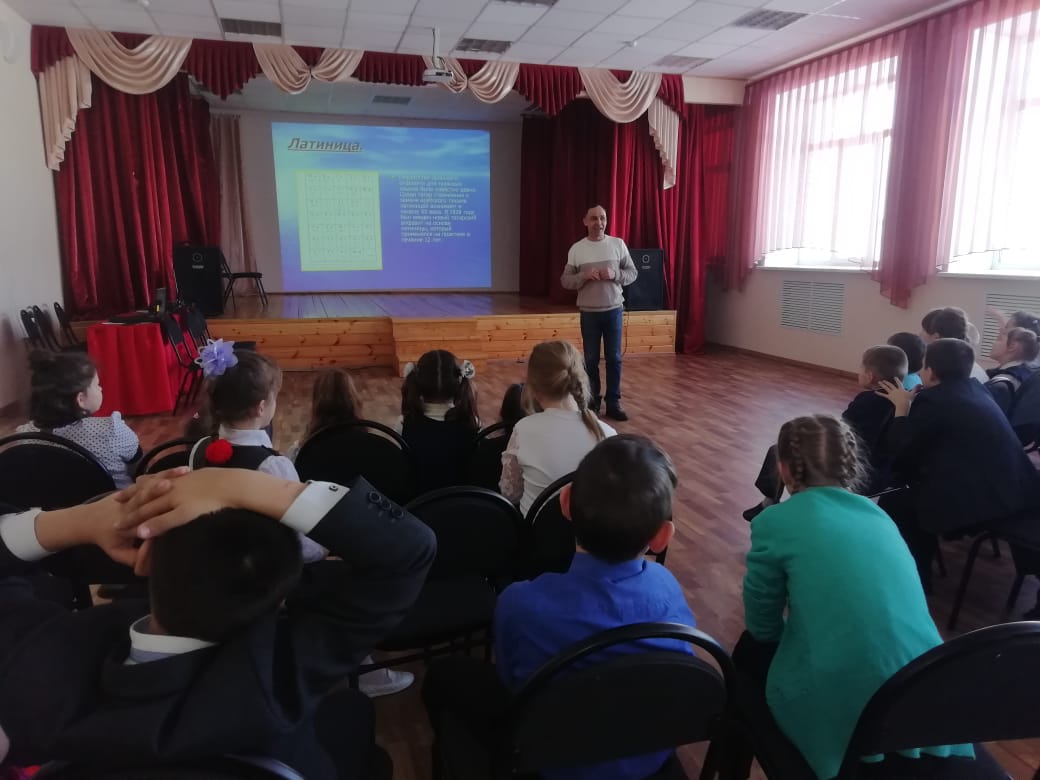
On 26 February 2020, a research associate of the museum and education department of Bolgar Museum-Reserve Krivosheyeva S. V. held an event entitled “The history of writing technology” for the students of the 4th grade of Bolgar sanatorium-type residential school.
People did not always know the art of writing. When it appeared, it was one of the most important discoveries in the history of a humanity. This art developed for a long time, during thousands of years. It is necessary to look at the history to imagine the emergence of Russian literacy.
At this event, the children learned that the most ancient and simple way of writing was pictography, which appeared in the Paleolithic era. The man began to express his thoughts and paint events in the form of drawings. The units of this writing – pictograms –were carved at first, then drawn on the walls of caves, on rocks, stones, horns and bones of animals and on birch bark.
In III-IV millennia B.C., in ancient Sumeria and in ancient Egypt another way of writing appeared – ideography. People began to paint not an event, but separate objects. Greeks named such Egyptian pictures as hieroglyphs (special symbols). A text written using hieroglyphs looks like series of drawings.
The extraordinary achievement of human civilization was so-called syllabic writing invented in II-III millennia B.C. In contrast to ideography, every symbol in it means not a word, but a separate syllable.
And final stage is alphabetical (sound) writing, when a separate sign (a letter) usually means one sound. The major strength of this way of writing was that only about 20-30 symbols needed to be learnt. This was a quite simple alphabet. Over time, the linguistic script was used almost everywhere.
At the lesson, the students themselves could see the writing, starting with pictograms and ending with Russian civil alphabet legitimized by Peter I.
Photos

Share on social networks